

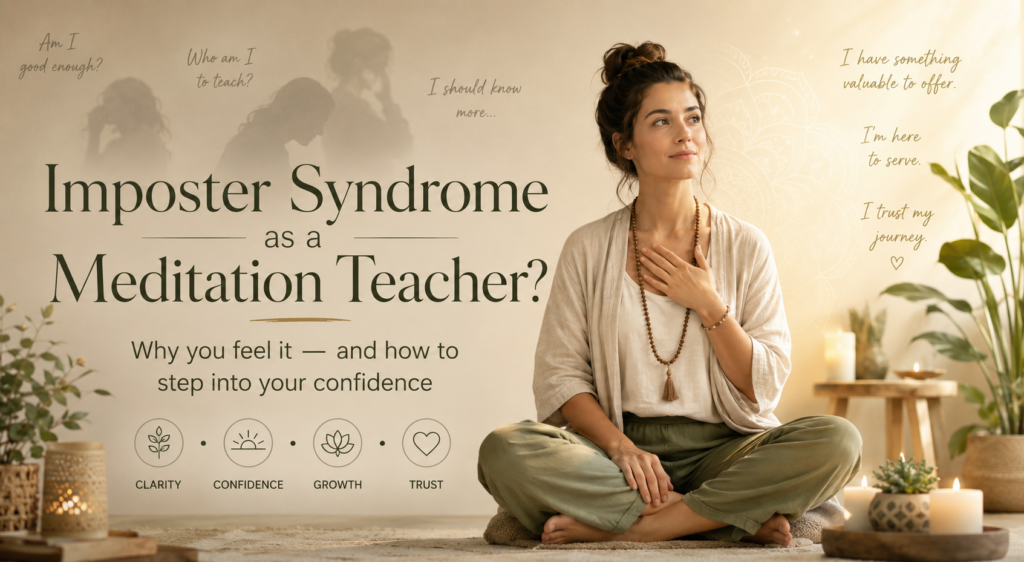
You’ve learned meditation.
You’ve practiced it.
You’ve even helped people feel calmer and more grounded.
But somewhere inside, a thought keeps coming up:
- “Am I really qualified to teach?”
- “What if someone knows more than me?”
- “Who am I to guide others?”
This is imposter syndrome—and almost every meditation teacher experiences it at some stage.
The problem is not that you’re not ready.
The problem is that your mind is questioning your authority before you fully step into it.
What Is Imposter Syndrome in Meditation Teaching?
Imposter syndrome is the feeling that:
“I’m not good enough yet, and people will eventually find out.”
Even when:
- You have knowledge
- You’ve seen results
- People appreciate your sessions
You still feel like you’re “not there yet.”
Why Meditation Teachers Experience This More Deeply
This isn’t just about skill.
It’s about identity.
As a meditation teacher, you may believe:
- “I need to be fully healed to guide others”
- “I should always be calm and perfect”
- “I shouldn’t struggle if I’m teaching this”
These expectations are unrealistic.
Meditation teachers are not perfect—they are practitioners who guide others through what they are also navigating.
The Hidden Belief Causing Imposter Syndrome
At the core, most teachers are operating from:
“I need to know everything before I can teach anything.”
But in reality:
- Teaching comes from experience, not perfection
- People don’t need a perfect guide
- They need someone relatable and one step ahead
Signs You’re Experiencing Imposter Syndrome
- You delay starting your sessions
- You overconsume courses but don’t implement
- You hesitate to charge money
- You compare yourself to other teachers
- You doubt your ability even after positive feedback
If this sounds familiar—you’re not alone.
The Truth Most People Don’t Tell You
Confidence doesn’t come first.
Action does.
Most meditation teachers think:
“Once I feel confident, I’ll start”
But the reality is:
“Once I start, confidence builds”
Why This Is Blocking Your Growth
When you stay in imposter syndrome:
- You don’t show up consistently
- You avoid visibility
- You delay creating offers
- You stay stuck in learning mode
And this keeps you from:
helping more people
building a sustainable path
growing your impact
The Shift: From “Am I Enough?” to “Can I Help?”
Instead of asking:
“Am I good enough to teach?”
Ask:
“Can I help someone feel even 10% better today?”
If yes—you are ready to begin.
How to Overcome Imposter Syndrome as a Meditation Teacher
1. Stop Waiting to Feel “Ready”
There is no final point where you suddenly feel ready.
Readiness comes from:
- showing up
- practicing
- teaching
Start before you feel prepared.
2. Focus on One Problem You Can Solve
You don’t need to guide everything.
Start with one area:
- overthinking
- stress
- sleep
- emotional calm
Clarity reduces self-doubt.
3. Use Your Own Journey as Authority
You don’t need external validation.
Your authority comes from:
- what you’ve experienced
- what has worked for you
- what you’ve seen help others
That is enough to begin.
4. Detach from Comparison
Comparison creates insecurity.
Remember:
- Someone ahead of you once started where you are
- Your audience is not looking for the “best teacher”
- They’re looking for the right teacher for them
5. Take Small Visible Actions
Instead of overthinking, do:
- Host a small session
- Share your learnings
- Create simple content
Action dissolves doubt.
6. Accept That Growth Feels Uncomfortable
Feeling like an imposter is not a sign to stop.
It’s a sign that:
you are stepping into something bigger
Growth always comes with discomfort.
What Changes When You Move Past This
- You start showing up confidently
- Your sessions feel more natural
- People trust you more
- You attract the right audience
- You grow faster with clarity
Most importantly:
You stop holding yourself back
Is it normal to feel like an imposter as a meditation teacher?
Yes. It’s extremely common, especially in the early stages.
Do I need certification to feel confident?
Certification can help, but confidence comes from practice and experience—not just credentials.
How do I know I’m ready to teach?
If you can help someone feel calmer, clearer, or more aware—you’re ready to start.
Will this feeling ever go away?
It reduces as you take action and build real experience.
Conclusion
Imposter syndrome is not proof that you’re unqualified.
It’s proof that:
you care about doing meaningful work
But if you keep waiting to feel “ready,” you delay your growth—and your impact.
You don’t need to be perfect to guide others.
You just need to:
- start
- stay consistent
- trust your journey
If you want to build confidence as a meditation teacher, create structured offers, and grow without self-doubt, join the CalmPreneur Meditation Trainer Bootcamp.
Learn how to:
- overcome imposter syndrome
- build real confidence through action
- attract and convert clients
- grow a sustainable meditation business
👉 Join here: https://calmpreneur.in/cpmt