

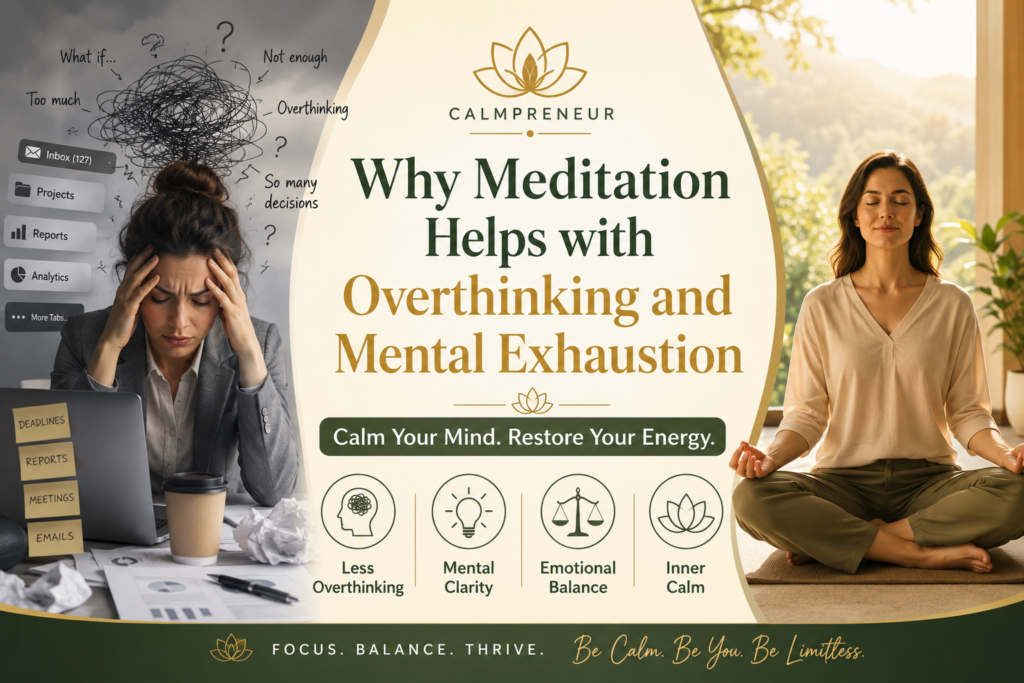
You wake up tired.
You struggle to focus.
Simple decisions feel overwhelming.
And no matter how hard you try to relax, your mind keeps running.
If this sounds familiar, you’re not lazy, unmotivated, or lacking discipline.
You may be experiencing something that millions of people struggle with today:
Overthinking and mental exhaustion.
The good news is that meditation offers a simple and natural way to interrupt this cycle and help your mind recover.
What Is Mental Exhaustion?
Mental exhaustion happens when your brain is constantly processing information without enough recovery.
Unlike physical tiredness, mental exhaustion doesn’t always improve with sleep.
You may experience:
- Constant overthinking
- Difficulty focusing
- Brain fog
- Irritability
- Low motivation
- Emotional overwhelm
- Trouble making decisions
- Feeling mentally “full”
Many people continue functioning while mentally exhausted, which makes it easy to ignore until it starts affecting work, relationships, and overall well-being.
Why Overthinking Drains So Much Energy
Most people think overthinking is simply “thinking too much.”
In reality, overthinking is often repetitive thinking without resolution.
Your mind keeps replaying:
- Conversations
- Mistakes
- Future scenarios
- Worst-case outcomes
- Unfinished tasks
The problem is that your brain treats many of these thoughts as problems that need immediate attention.
As a result, your nervous system stays activated even when there is no real danger.
Over time, this constant mental activity becomes exhausting.
The Hidden Cost of an Always-Busy Mind
When your mind never gets a break, you may notice:
Reduced Focus
Your attention becomes scattered because your mental energy is divided across multiple thoughts.
Emotional Fatigue
Constant thinking creates emotional stress, even if nothing is happening externally.
Poor Sleep
Many people struggle to fall asleep because their mind refuses to slow down.
Decision Fatigue
Even simple choices start feeling difficult because your brain is already overloaded.
This is why many people feel exhausted despite spending most of the day sitting at a desk.
How Meditation Helps Stop the Cycle
Meditation doesn’t eliminate thoughts.
It changes your relationship with them.
Instead of getting pulled into every thought, you learn to observe them without reacting.
This creates mental space, which is exactly what an overworked mind needs.
1. Meditation Gives Your Brain a Recovery Period
Your body rests while you sleep.
Your mind needs rest too.
Meditation provides moments where your attention is no longer consumed by constant analysis.
Even a few minutes of stillness can help reduce mental overload.
2. It Breaks the Overthinking Loop
Most overthinking happens automatically.
Meditation trains you to notice when your mind is spiraling and gently return to the present moment.
Over time, this reduces the habit of getting trapped in repetitive thinking patterns.
3. It Calms the Nervous System
Overthinking often keeps the body in a low-grade stress response.
Meditation activates the relaxation response, helping your system shift from stress mode to recovery mode.
This is why many people feel calmer after a meditation session—even when their external situation hasn’t changed.
4. It Improves Mental Clarity
A cluttered mind struggles to think clearly.
Meditation helps create space between thoughts, making it easier to:
- Focus
- Prioritize
- Make decisions
- Stay present
Many people describe this as feeling mentally lighter.
5. It Helps You Respond Instead of React
When you’re mentally exhausted, small challenges can feel overwhelming.
Meditation builds awareness, allowing you to pause before reacting.
This helps conserve emotional and mental energy throughout the day.
A Simple Meditation Practice for Overthinking
If your mind feels constantly busy, start here.
Step 1: Sit Comfortably
Find a quiet place where you won’t be interrupted.
Step 2: Close Your Eyes
Allow your shoulders and jaw to relax.
Step 3: Focus on Your Breath
Notice your inhale and exhale.
Don’t force it.
Just observe.
Step 4: Notice Thoughts Without Following Them
When thoughts appear, acknowledge them and gently return to your breath.
Step 5: Practice for 5–10 Minutes
Consistency matters more than duration.
Common Mistakes People Make
Trying to Stop Thoughts Completely
The goal of meditation isn’t to have a blank mind.
The goal is to become less controlled by your thoughts.
Only Meditating When Overwhelmed
Meditation works best as a daily practice, not just during stressful moments.
Expecting Instant Results
Mental habits develop over years. Give yourself time to experience the benefits.
Who Can Benefit Most?
Meditation can be especially helpful if you:
- Struggle with overthinking
- Feel mentally exhausted most days
- Experience brain fog
- Find it difficult to relax
- Constantly worry about the future
- Feel emotionally drained by daily life.
Can meditation stop overthinking?
Meditation helps reduce the tendency to get caught in repetitive thought patterns. With consistent practice, many people notice greater mental clarity and calm.
How long should I meditate daily?
Start with 5–10 minutes per day. Consistency is more important than long sessions.
Can meditation help with mental exhaustion?
Yes. Meditation gives your mind an opportunity to recover from constant stimulation and mental overload.
How quickly will I notice results?
Some people feel calmer after a single session, while deeper changes typically develop after a few weeks of regular practice.
Conclusion
Overthinking isn’t a sign that you’re thinking deeply.
Often, it’s a sign that your mind hasn’t had a chance to rest.
Meditation creates the space your brain needs to recover.
It helps you step out of mental overload, calm your nervous system, and reconnect with the present moment.
The goal isn’t to stop thinking.
The goal is to stop carrying every thought as a burden.
And that’s where real mental clarity begins.
Ready to Turn Meditation Into a Life Skill and a Meaningful Career?
If overthinking and mental exhaustion have made you realize the importance of inner calm, why not learn a skill that can transform not only your life but also the lives of others?
Join our 3 Day Meditation Trainer Bootcamp and discover how to:
Use meditation to reduce stress, overthinking, and mental fatigue
Build a consistent meditation practice for yourself
Learn the foundations of guiding meditation sessions
Understand how to teach meditation with confidence
Explore how to become a Meditation Trainer and create a meaningful career
Whether you’re looking for personal transformation or want to help others experience the benefits of meditation, this bootcamp is the perfect first step.
👉 Register for the 3 Day Bootcamp: https://calmpreneur.in/cpmt
Learn Meditation. Practice Meditation. Teach Meditation. Become a Meditation Trainer.