

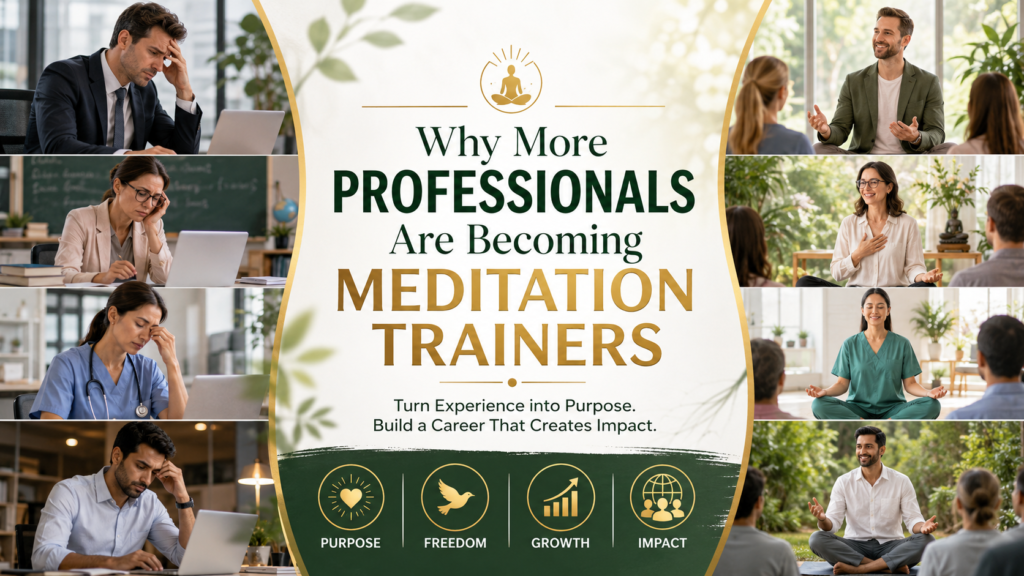
A high-paying job.
A respected designation.
A busy calendar.
On paper, it looks like success.
But behind the promotions, deadlines, and long working hours, many professionals are asking themselves a deeper question:
“Is this the life I really want?”
Across India and around the world, professionals are no longer chasing only financial success—they’re looking for meaningful work, better balance, and the opportunity to create a positive impact.
That’s why an increasing number of people are choosing to become meditation trainers.
Not because it’s easy.
But because it aligns with the kind of life they truly want to build.
The Shift from Career to Calling
For decades, career decisions were driven by salary and job security.
Today, people are looking for something more:
- Work that aligns with their values.
- The freedom to manage their own time.
- Better mental health.
- A chance to help others.
- A career that feels fulfilling—not just financially rewarding.
Meditation training offers exactly that combination.
It allows professionals to transform their own lives while guiding others toward greater calm, clarity, and emotional well-being.
Why Professionals Are Making the Switch
1. They Have Experienced the Benefits Firsthand
Most meditation trainers don’t start because they’re looking for a business.
They start because meditation changed their own lives.
Perhaps it helped them:
- Manage workplace stress
- Sleep better
- Reduce anxiety
- Improve focus
- Handle emotional challenges
- Feel more present with family
After experiencing these changes personally, many feel inspired to share the same gift with others.
The best teachers often begin as sincere students.
2. They Want Work That Creates Real Impact
Many careers focus on solving business problems.
Meditation trainers help solve human problems.
They help people:
- Manage stress.
- Build emotional resilience.
- Improve focus.
- Develop healthier habits.
- Find inner peace.
Few careers allow you to witness such meaningful transformation in someone’s life.
That sense of purpose is one of the biggest reasons professionals choose this path.
3. They Want More Freedom
Traditional careers often come with:
- Fixed schedules
- Long commutes
- Limited flexibility
- Constant deadlines
Meditation trainers have the opportunity to create a more flexible lifestyle.
They can choose to teach:
- Online
- Offline
- Weekends
- Corporate programs
- One-on-one sessions
- Group workshops
As their practice grows, they gain greater control over how and when they work.
4. Wellness Is One of the Fastest-Growing Industries
Mental health and workplace well-being have become global priorities.
Organizations, schools, healthcare providers, and individuals are increasingly investing in stress management and mindfulness programs.
As awareness grows, so does the demand for skilled meditation trainers who can guide people with confidence and authenticity.
Meditation Teaching Isn’t Just About Guiding Sessions
One of the biggest misconceptions is that meditation trainers simply lead breathing exercises.
In reality, they often become facilitators of personal growth.
A successful meditation trainer learns how to:
- Build trust with participants.
- Create safe learning environments.
- Communicate with empathy.
- Guide meaningful transformation.
- Inspire consistent practice.
It’s a profession that combines knowledge, presence, leadership, and compassion.
You Don’t Need to Quit Your Job Immediately
Many successful meditation trainers begin while still working full-time.
They start by:
- Practicing meditation consistently.
- Learning professional teaching methods.
- Conducting sessions for friends or small groups.
- Building confidence through experience.
As they grow, many gradually transition into teaching more regularly.
You don’t have to take a leap—you can build a bridge.
Skills That Make Professionals Great Meditation Trainers
Professionals already bring valuable strengths into meditation teaching.
These include:
Communication
The ability to explain concepts clearly.
Leadership
Helping people feel supported and motivated.
Discipline
Showing up consistently and building trust.
Problem Solving
Understanding people’s challenges and offering practical guidance.
When combined with meditation training, these skills become incredibly powerful.
Common Fears That Hold Professionals Back
Many aspiring trainers hesitate because they think:
- “I’m not spiritual enough.”
- “I’m not an expert.”
- “There are already too many meditation teachers.”
- “What if nobody joins my sessions?”
These fears are normal.
But remember:
People aren’t looking for a perfect teacher.
They’re looking for someone who understands them, listens deeply, and can genuinely help.
Authenticity will always matter more than perfection.
What Makes a Successful Meditation Trainer?
It isn’t about having the most certifications.
It’s about consistently practicing what you teach.
Successful meditation trainers are:
- Compassionate
- Patient
- Curious
- Consistent
- Open to continuous learning
Knowledge attracts attention.
Authenticity builds trust.
Is Meditation Training the Right Career for You?
You may be well suited to this path if you:
- Enjoy helping people grow.
- Value personal development.
- Want more flexibility in your work.
- Believe in lifelong learning.
- Feel fulfilled when making a positive impact.
If that sounds like you, meditation training may be more than a career—it could become your calling.
Can professionals become meditation trainers without prior teaching experience?
Yes. Most meditation trainers begin without formal teaching experience. With proper training, regular practice, and guidance, anyone can develop the skills needed to teach confidently.
Is meditation teaching a full-time career?
It can be. Many trainers begin part-time and gradually build a full-time practice through workshops, coaching, corporate sessions, and online programs.
Do I need to be highly spiritual?
No. A genuine commitment to learning, practicing, and helping others is far more important than fitting a particular image.
Can meditation trainers earn an income?
Yes. Many trainers create sustainable income by offering group classes, one-on-one coaching, corporate wellness programs, retreats, and online courses.
The world doesn’t just need more successful professionals.
It needs more calm, compassionate leaders.
People who can guide others through stress, uncertainty, and emotional challenges.
That’s why more professionals are choosing to become meditation trainers—not simply to change careers, but to change lives.
If you’re looking for work that offers purpose, flexibility, personal growth, and meaningful impact, meditation training may be the opportunity you’ve been searching for.
Sometimes, the most rewarding career isn’t the one that climbs the highest ladder.
It’s the one that helps others rise.
Ready to Become a Meditation Trainer?
If you’ve been thinking about turning your passion for meditation into a meaningful profession, now is the perfect time to begin.
Our 3-Day Meditation Trainer Bootcamp is designed to help aspiring trainers build the confidence, skills, and clarity needed to start their journey.
In the bootcamp, you’ll learn:
Practical meditation techniques for personal transformation
How to confidently guide meditation sessions
The essential skills every successful Meditation Trainer needs
How to start attracting your first students
A roadmap to building a purpose-driven meditation career
Whether you want to teach part-time, build a full-time practice, or simply deepen your understanding of meditation, this bootcamp is your first step.
👉 Register here: https://calmpreneur.in/cpmt